.svg)




Harmonizing Science and Scripture: Exploring Non-Natural Phenomena in Creation

.svg)


You may be surprised to hear that the Genesis account of creation doesn’t appear as far-fetched as some assert. From science itself, the best thinkers have already unfolded the reality of non-natural phenomena in the universe.
Many scientists assert the paradoxical nature of time, space, matter, and energy. Some admit to a perplexing and bizarre amount of evidence that requires them to make sense of the non-natural realm. Findings reveal that which defies the classic laws of physics.
This does not mean they should cease to pursue natural explanations. That is the scientific method and ought to remain robust. The mantra should be, “There is a natural explanation for this, and we seek to understand it.” Even so, science at this time shows evidence—yes, evidence—of phenomena beyond the scope of traditional physics. That phenomenon is viewed as “non-natural,” and it does not appear some of this will change anytime soon.
What do I mean by the “non-natural” evidenced in our world?
Though most scientists avoid the term otherworldly, since they are committed to finding a natural explanation, they acknowledge this counterintuitive realm of particles at the microscopic level, which they have discovered in a field called quantum mechanics that appears to contradict traditional laws of physics. Let’s consider five of these “non-naturals.” Though some would say the following cannot be, somehow they are.
Five Non-Naturals of Virtual Particles
1. Dual nature: These particles are simultaneously entirely matter and energy. Such particles are both particle-like and wave-like, challenging classic physics.
2. Existence paradox: These particles challenge traditional measurements of position and momentum because they can quickly and simultaneously occupy numerous places while also being in just one place, creating challenges in precisely determining both their position and speed, in contrast to classical measurements.
3. Spooky entanglement: These particles are connected yet spatially apart. Quantum particles can become entangled, even when they are far apart. This entanglement is surprising because, according to classical physics, it shouldn’t happen. Some scientists find it puzzling and challenging to explain using classical ideas.
4. Observer-dependent states: There is more than one particle—oh wait, no, there is just one. Such particles can exist simultaneously in more than one state until a scientist observes them, at which point they “collapse” into one of the states. This property makes scientific observation in quantum physics more complex than classical physics.
5. Quantum tunneling: These particles exhibit a remarkable ability to pass through obstacles seemingly “magically,” a feat impossible within the framework of classical physics. They do so by appearing to tunnel or sneak through barriers, even though they appear to lack that ability according to current laws of physics.
Again, each of these phenomena has been observed. Though some would say they cannot be, they are.
Evidence of the Non-Natural Macroscopically
Now let’s go big, considering black holes, dark matter, dark energy, and the Big Bang. Something non-natural permeates these realms or realities.
Black Holes
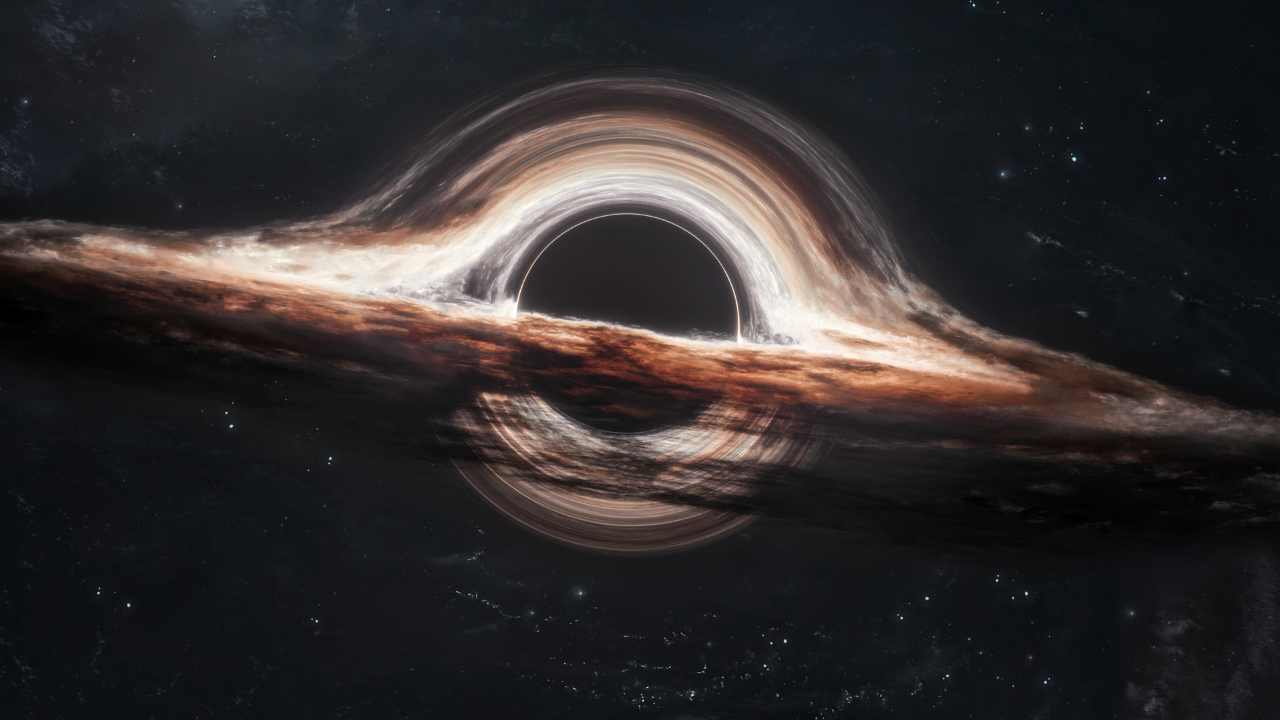
A black hole is a collapsed star that has been exhausted of its nuclear fuel. It collapses due to the near-infinite force of gravity turning inward. This realm is so dense that gravity pulls in light, and that light cannot escape. At this juncture, the gravitational force is non-natural in creating a barrier that is one way and exceeds any known law of physics.
We know black holes are there, even though we cannot see them directly, because we observe objects and matter getting pulled into them. It’s a bit like a vacuum cleaner that we can’t see, but we can see debris disappearing into it.
One stunning observation is that time appears to slow down when nearing the horizon (event horizon) of a black hole, which suggests time is not a constant but behaves differently due to relative motion and the strength of the gravitational field. Some scientists conjecture about a feature of a black hole that boggles the mind. Nearing a black hole, given we could, time would slow down, referred to as time dilation. For example, if we were to hover near the event horizon of a black hole for what felt like an hour, an observer far away might perceive that years have passed for us. Time dilation for massive black holes could mean that billions or even trillions of years could pass for those far away, while for us near the event horizon, only a brief moment elapses! Metaphorically, some refer to it as the freezing of time. This is counterintuitive, non-natural, and beyond remarkable.
With a sense of wonder, we are on the outside, seeing the unseen and knowing the unknowable—at least, at this time.
Dark Matter and Dark Energy
Scientists have concluded on the macroscopic level there is what they refer to as dark energy and dark matter.
Dark energy is a mysterious force responsible for the universe’s accelerated expansion. Unlike gravity, which attracts objects toward each other, such as an apple falling from a tree, dark energy exhibits an anti-gravity effect. Imagine throwing a ball upward: instead of slowing down and eventually falling back down, dark energy causes the ball to continue rising, increasing its upward acceleration over time. This counterintuitive property of dark energy is one of the key puzzles in cosmology.
Dark matter is a type of matter that does not emit, absorb, or interact with electromagnetic radiation, including light. It is called “dark” because it is invisible and cannot be directly observed through traditional optical or electromagnetic means. This “matter” constitutes a significant portion of the universe’s mass. While it remains undetectable through direct visual observation, scientists have inferred its existence through various methods, including the study of gravitational effects, such as gravitational lensing. Dark matter is fundamentally different from the familiar matter made up of atoms and subatomic particles, so its nature and composition remain more than a topic of curiosity, and also presents a puzzle to cosmologists.
Dark energy pushes the universe’s expansion, while dark matter exerts gravitational attraction, effectively pulling matter together. Scientists are puzzled by this interplay because it defies traditional physics. Dark matter, given its gravitational pull, should dominate and act as the greater force, drawing everything closer together. However, dark energy seems to counteract this by pushing the universe apart with even greater force. This apparent contradiction challenges our understanding of the cosmos.
All of this is non-natural and exists at the macroscopic scale.
The Big Bang: The Precondition, Birth, and Aftereffects
What do scientists conjecture about the non-natural phenomena in the universe’s precondition, birth, and aftereffects?
First, before the Big Bang, the conditions were beyond imagination, defying traditional laws of physics. The whole realm must be pictured as non-natural. Time lacked chronology; there was no past, present, or future. Space existed without dimensions; there was no here or there. Matter possessed the “ability” to emerge from nothingness spontaneously; there was no cause and effect. And energy manifested a mysterious force that could magically “cause” things to appear and disappear everywhere at once without waiting or sequence. All of these things defy our conventional wisdom.
Second, the Big Bang itself happened in a single blink of an eye. Scientists refer to this as the singularity. From a state of almost nothingness, the whole cosmos burst into existence. Just before the gigantic kaboom, there existed an almost infinite density of non-natural matter and energy in the non-natural space and time described. Of course, this defies our understanding of the law of physics. In stating this singularity as nearly infinite in density, most concur that there is a realm that can only be defined as non-natural. This phenomenon resides outside the scope of our imagination and so far empirical inquiry. Again, a nanosecond prior to the Big Bang, time had no chronology, space had no dimensions, matter had the potential (somehow) to emerge immediately from nothing, and energy as a mysterious force could cause matter to appear everywhere at once.
Third, the immediate aftermath of the Big Bang is called cosmic inflation, where the universe expanded exponentially from something nearly infinitely tiny to a vast and expanding reality. This happened fast and far, but as it expanded, it increased in velocity, which was an ever-increasing rate. Many assert it expanded faster than the speed of light. But here’s the intellectual stumbling block: it went from a particle smaller than an atom to the size of our observable universe in a fraction of a second. In the blink of an eye, the whole universe inflated to the boundaries of our observable universe.
Were Such Non-Naturals at Work in Genesis 1?
In putting it all together—quantum mechanics, black holes, dark energy, dark matter, and the “events” surrounding the Big Bang—we have non-natural phenomena that puts believers in Jesus Christ in a position to say, “In light of these findings and theories, Genesis 1 is not necessarily to be interpreted as science fiction!
I believe Genesis 1 describes non-natural events that align with the non-natural scientific findings. Yes, one day, science could have natural explanations for everything. That is the goal of science. On the other hand, science may conclude the evidence for the non-natural must be accepted as part of our “natural” worldview. The nature of reality will make room for phenomena that does not conform to classical natural laws.
So, why do I say there is a “harmonizing” relationship between science and Scripture? Thinking of the Big Bang . . .
While there may be questions about interpreting the six days of creation mentioned in Genesis, one thing remains clear: God’s creative power knows no bounds. Just as He can operate outside the natural realm, instantaneously creating from nothing (ex nihilo), He can work within the natural order in ways that align with scientific exploration and the narrative of Genesis 1.
As far back as the fourth century AD, theologians have stated it as “ex nihilo,” meaning “out of nothing.” Is science just now catching up? Regardless, if science claims that everything came out of nothing spontaneously, should we not be permitted to say the same based on Genesis 1?
Today, many scientists proclaim that all things appeared at once without waiting or in sequence and instantaneously with equal magnitude in the blinking of an eye. The Genesis 1 account of creation need not be viewed as a far-fetched fairy tale in light of scientific discoveries. The only factor that raises a question is the report that God created over six days, traditionally interpreted as twenty-four-hour periods. But nearing the edge of infinite gravity, like a black hole’s center, time and timelessness would operate according to God’s power and purpose. God’s forces during the act of creation would not be dissimilar to what scientists propose and describe about the non-natural phenomena in the cosmos. In my opinion, for example, as part of His creative brilliance, in a nanosecond He created over the six days the reality we have observed, yet it could be a trillion years old from a different distance in the warped space-time. It is just a matter of perspective like scientists propose with time dilation. Time is relative.
As for the seven days of twenty-four hours, Genesis 1 isn’t working backward from our experience and inserting the seven-day week based on that experience. The narrative reports God designed this at creation. God had a plan. In His wisdom, He intended to teach us to work six days and rest on the seventh. He models. We imitate. If I were God, I’d do something like that. He always proposes. It shouldn’t surprise any believer.
Yes, some are troubled by the six days since they believe these are ages lasting hundreds of millions of years. But without debating this, such a person should still agree that God can do whatever He wishes in non-natural ways. The bottom line is that if one wishes to question the six-day creation as a mythical story, they must also question the proposed aftereffects of the Big Bang since scientists have composed a narrative where in a fraction of a second the universe expanded at an exponential rate, going from a state much smaller than the size of a proton to a size significantly larger than the observable universe we perceive today, estimated to be about 93 billion light-years in diameter. That happened, they pen, before we finished blinking. Really?
Maybe this is why Stephen Hawking said about black holes that they are something out of science fiction. But he followed up with: truth is stranger than fiction. Hmmm.
%20(1).avif)
Questions to Consider
- How have your thoughts on the Genesis story of creation evolved over your lifetime? Why have they evolved like this? Assuming you believe in the traditional interpretation of Genesis 1, do you still see it as “far-fetched” and something you simply accept by faith, or are their more “scientific” reasons for believing as you do? Explain your answer.
- Why might some people have an easier time accepting “non-naturals” like the five Emerson listed above, but still refuse to believe in the creation story or even other miracles found in the Bible? Is there something else at play here that is adding to their resistance to believe in these biblical “non-natural” events?
- In Emerson’s opinion, Genesis 1 describes non-natural events that align with the non-natural scientific findings. Do you agree or disagree? Explain your answer.
- Emerson wrote, “The only factor that raises a question is the report that God created over six days, traditionally interpreted as twenty-four-hour periods.” Is this a matter that we should get hung up on? Why or why not?


